Bridging Modern Frontends with Scalable .NET Core APIs
How to design high-performance web applications combining modern Next.js/React frontends with robust, type-safe C# .NET Core backends.
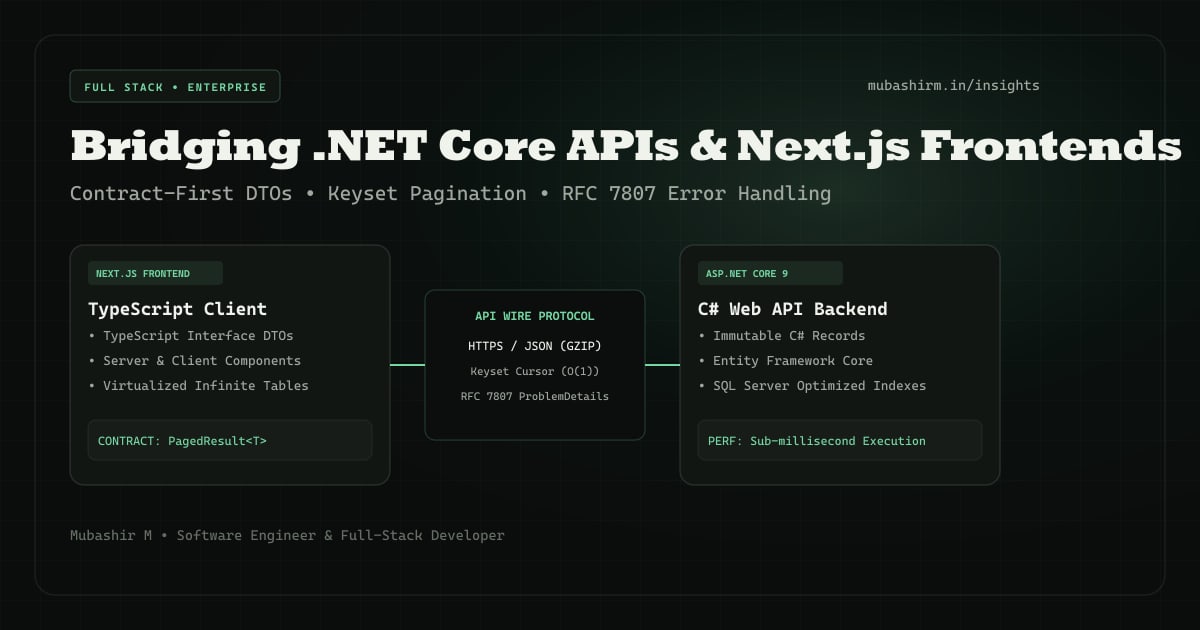
Why .NET Core and Next.js are an Enterprise Powerhouse
When building enterprise software requiring high concurrency, strict type safety, and rich user interfaces, few technology pairings are as effective as ASP.NET Core on the backend coupled with Next.js or React on the frontend.
ASP.NET Core delivers world-class throughput, rock-solid dependency injection, Entity Framework Core query capabilities, and mature authentication ecosystems. Meanwhile, Next.js provides modern component composition, lightning-fast client hydration, and first-class SEO capabilities.
1. Contract-First DTO Design & Serialization Discipline
The backbone of a successful full-stack application is the API contract. A common trap is exposing raw Entity Framework Core models directly to the controller endpoints. This leads to circular reference bugs, over-fetching database columns, and accidental exposure of internal database identifiers.
Always introduce dedicated Request and Response Data Transfer Objects (DTOs). In C#, using record types provides immutability, built-in value equality, and clean JSON serialization semantics.
// Clean, immutable API Response DTO in C#
public record EmployeeResponseDto(
    Guid Id,
    string FullName,
    string Department,
    string RoleTitle,
    DateTime CreatedAtUtc
);

// Controller endpoint returning paginated results
[HttpGet]
[ProducesResponseType(typeof(PagedResult<EmployeeResponseDto>), StatusCodes.Status200OK)]
public async Task<IActionResult> GetEmployees([FromQuery] PaginationFilter filter)
{
    var pagedData = await _employeeService.GetPagedEmployeesAsync(filter);
    return Ok(pagedData);
}
2. Optimizing Data Transfer: Keyset Pagination over Large Offsets
In enterprise dashboards and management suites, displaying large tables is routine. Standard offset pagination (e.g., OFFSET 10000 ROWS FETCH NEXT 50) forces relational databases like SQL Server or PostgreSQL to scan thousands of records before returning results, degrading performance as tables grow.
Keyset pagination (cursor-based pagination) utilizes indexed ordering columns (such as Id or CreatedAtUtc) to deliver consistent sub-millisecond query execution regardless of dataset size.
3. Clean Error Contracts with RFC 7807 Problem Details
Nothing frustrates frontend development more than receiving inconsistent backend errors — an HTML 500 error on one endpoint, a raw string on another, and a custom JSON envelope on a third.
ASP.NET Core provides built-in support for RFC 7807 Problem Details. By standardizing your API error responses to ProblemDetails, your TypeScript frontend can implement a unified error interceptor that handles validation errors, concurrency conflicts, and authorization failures predictably.
“A predictable API contract is the highest form of respect between frontend and backend engineers.”
Summary
Pairing .NET Core's raw performance and architectural discipline with the responsiveness of Next.js allows teams to build digital products that feel instantaneous to users while remaining secure and manageable for engineering organizations.
Business Management Suite — Enterprise ERP UI & .NET Foundation
A modular workspace concept connecting CRM, finance, and administration workflows to high-throughput .NET Web APIs.
Explore this project in my showcase