A Practical Guide to Maintainable Frontend Architecture in Large Applications
Architectural patterns for structuring modern React and Angular applications — clean component boundaries, state separation, and contract-driven APIs.
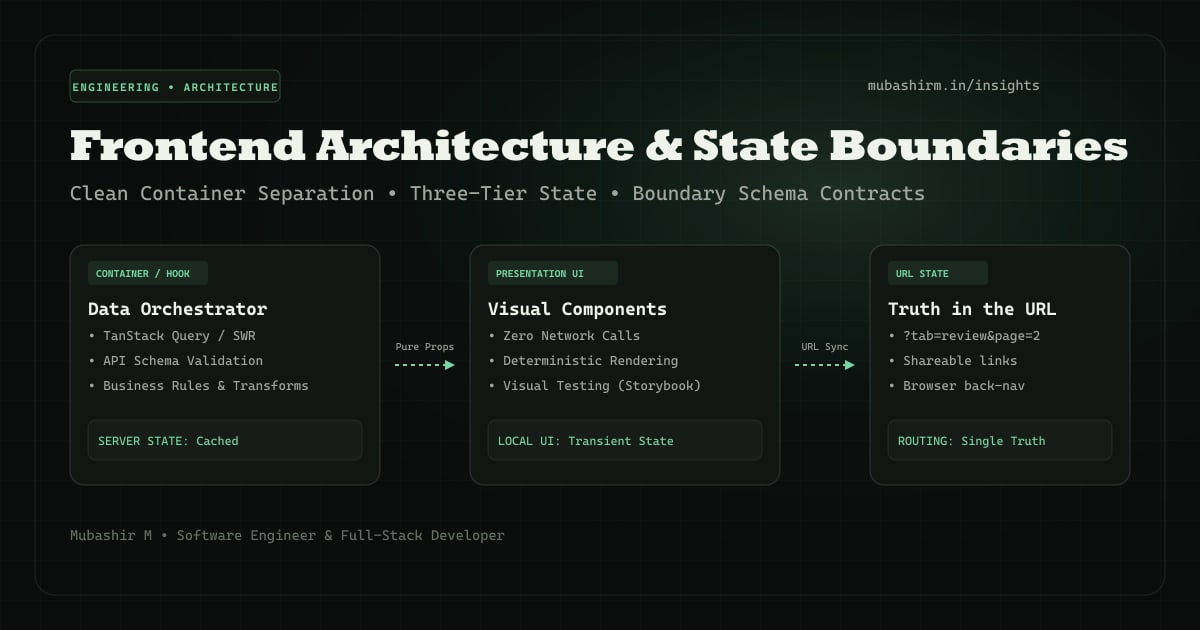
The Real Cost of Architectural Drift
In modern web development, starting a project is easy. Keeping it understandable, testable, and pleasant to maintain after six months of active feature development is where most applications struggle. What often starts as an innocent component tree gradually devolves into deeply nested prop-drilling, tightly coupled network calls inside presentation components, and an unpredictable web of global state listeners.
Maintainability is rarely lost in a single monumental design mistake; it degrades through dozens of micro-shortcuts. When an engineer needs to add a badge or trigger an API request, putting it directly into the nearest component seems harmless — until three other components need the same data, leading to duplicated state and synchronization bugs.
1. The Container vs. Presentation Boundary Still Matters
Despite evolving component paradigms, separating presentation from data orchestration remains one of the highest-leverage architectural patterns you can adopt. In both Angular and React ecosystems, your components should fall cleanly into two categories:
Presentational components receive pure props/inputs and emit events/outputs. They have zero awareness of network clients, local storage, or global stores. Container components (or custom hooks in React, smart feature components in Angular) orchestrate data retrieval, transformation, and side-effects.
2. The Three Tiers of State: Avoid the Global Store Trap
One of the most frequent antipatterns in enterprise frontends is treating every piece of data as 'global state'. Redux, NgRx, and Zustand are powerful, but throwing server responses, modal open/close booleans, and URL filter parameters into the same global bucket leads to unnecessary re-renders and cognitive overload.
A robust frontend categorizes state into three distinct tiers:
// Anti-pattern: Syncing server responses into manual global state
// Recommended: Contract-driven query hook with typed caching
export function useTradingJournal(dateRange: DateRange) {
  return useQuery({
    queryKey: ['journal-entries', dateRange.from, dateRange.to],
    queryFn: () => journalApi.fetchEntries(dateRange),
    staleTime: 5 * 60 * 1000, // 5 min fresh cache
    select: (data) => transformToTimeline(data), // pure data shaping
  });
}
3. Contract-Driven Types & Boundary Validation
A major source of runtime exceptions in single-page applications is trusting that the backend API will always return the shape expected by the frontend. In TypeScript codebases, developers often define interfaces that describe what they hope the backend sends, with zero runtime validation.
By introducing lightweight schema validation (using tools like Zod) at the API boundary, runtime mismatches are caught immediately at the network edge with clear error logging, rather than crashing UI components downstream.
“Architecture isn't about writing more code; it's about establishing clear boundaries that prevent changes in one layer from breaking another.”
Key Takeaways for Sustainable Codebases
A maintainable frontend isn't defined by which framework or UI library you choose. It's defined by how cleanly your team separates concerns. Keep your presentation pure, respect the URL as the source of truth for view state, and enforce strict boundary contracts with your APIs.
MubiQ — Trading Journal Workspace
Built with Next.js & TypeScript, focusing on strict state separation and rapid keyboard review loops.
Explore this project in my showcase